Lesson · beginner · updated 2026-10-25
When five small knobs multiply, Wave 1 becomes a wall
Measure all 318 waves before Wave 1 becomes a wall.
In Demon Attack (demonattack.tlatoani.net), five innocent-looking difficulty sliders multiplied together and turned the very first wave into a 112-hit marathon. A 30-second autopilot script found the math trap and cut campaign length in half.
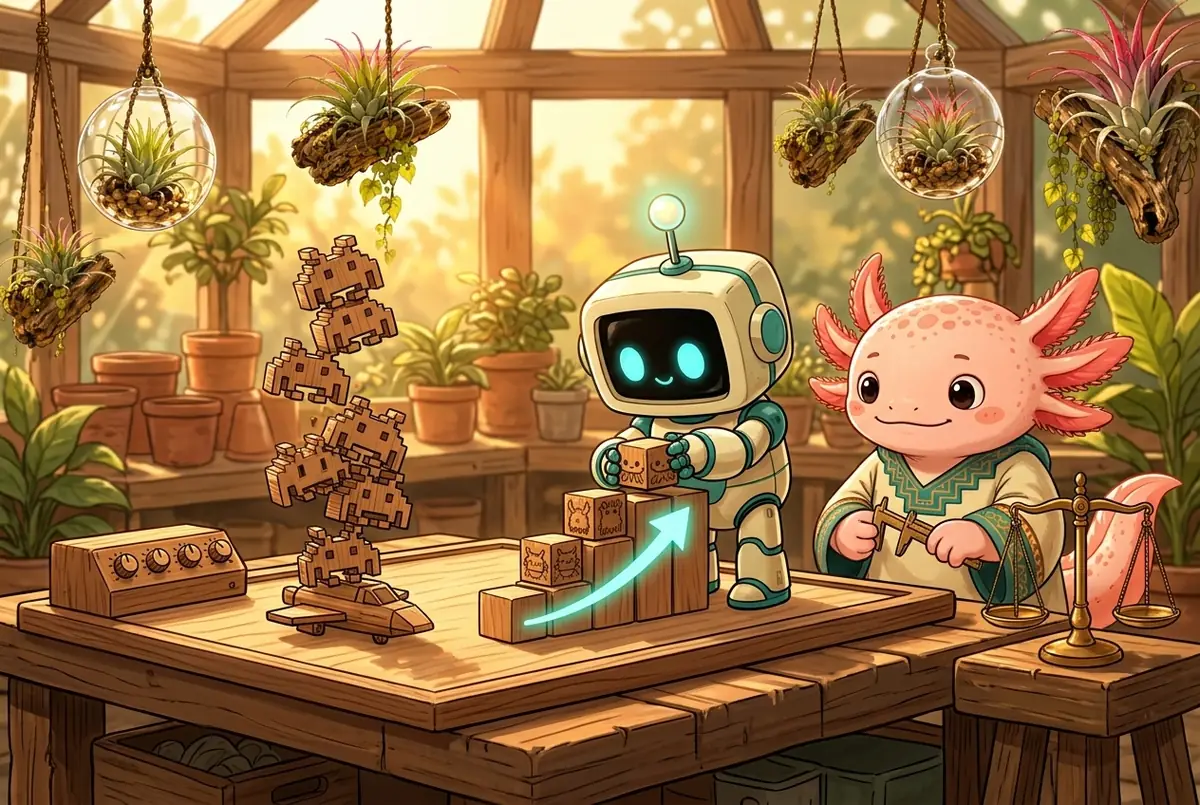
When you build a game with an AI assistant, it is tempting to ask for lots of richness: "Add five difficulty modes! Add enemy reinforcements! Make late-stage routes tougher! Let big demons split into baby demons! Give elites armor and shields!"
The AI will happily build every single one of those systems. And each system, on its own, will look completely reasonable in the code.
Then you press Start on Wave 1, and the first sixty seconds feel like fighting a brick wall. That is exactly what happened during the making of Demon Attack (8007342/demon_attack)—and the way it was fixed works for any game you build.
The Trap: Five Reasonable Knobs That Multiply
On paper, Wave 1 of Demon Attack only started with 4 enemies totaling 8 health points. That sounds like a gentle 10-second warm-up.
Why did it actually take 73 hits on Normal and 112 hits on Hard to survive Wave 1?
Because five separate systems were quietly multiplying each other:
- The route settings added 3 reinforcement waves (
+9enemies). - Each reinforcement wave inherited full escalated health instead of sharing a wave budget.
- Splitting demons spawned child demons when hit.
- High-heat waves promoted ordinary demons into shielded and armored elites without a wave-wide cap.
- 120 enemy bullets rained down during that first wave, forcing the player to dodge instead of shoot.
8 initial health had quietly compounded into 9.1× to 14× as much work before the player even reached Wave 2!
The Fix: Have the Computer Play All 318 Waves Before You Do
Humans cannot manually playtest 53 waves across 6 difficulty modes every time a number changes. You get tired by Wave 4.
Instead, ask your AI to build two tiny command-line tools:
- A Wave Auditor (
tools/analyze_difficulty.dart): Prints a table showing the true total hits required for every wave once reinforcements, splits, shields, and armor are added up. - A Robot Test Pilot (
tools/profile_difficulty.dart): A simulated player that flies through the entire campaign at super-speed using the real game rules and reports how many minutes each tour takes and how many times a human would lose a life.
Once the table made the hidden multiplier visible, fixing it was simple:
- Reinforcements and boss escorts now share their parent wave's health pool instead of multiplying it.
- Ordinary enemies are capped at 5 HP, and elite promotions have a strict per-wave ceiling.
- Result: Wave 1 dropped from 73 hits → 17 hits on Normal (and 112 → 21 on Hard), and the full Normal campaign went from an exhausting 110-minute slog to a crisp 48-minute arcade adventure.
Watch Out for Whole-Number "Cliffs"
In retro arcade games, health and damage are usually whole numbers (1, 2, 3...). That creates hidden cliffs:
- If most enemies have 3 HP, raising a weapon's damage from
1to2cuts shots-to-kill from3to2. - Raising that weapon's damage from
2to3suddenly turns every 3-HP enemy in the game into a one-shot kill! - Even trickier: if an elite enemy has 1 Shield + 1 Armor + 1 Hull, and leftover damage does not spill over between layers, a gun that does
1damage and a gun that does99damage both take 3 shots to defeat it.
Teach One New Thing at a Time (in 7 Words)
Instead of making players read a manual before playing, Demon Attack pauses the incoming wave just offscreen for 4.5 seconds the first time a new enemy or power-up appears, showing its pixel portrait and a 5–9 word tip (like "Shatter shields before they recharge"). You learn by playing, one surprise at a time.
Tlatoāni & Mācron
Tlatoāni (mashing the fire button with both gill-frills fluttering): "You told me Wave 1 had four little bats! Why have I been shooting for two minutes?!"
Mācron (holding up a long printout from the Robot Test Pilot): "Good news: there were four bats. Bad news: they invited nine cousins, six split in half, and three put on titanium helmets. Let me cap the family reunion."
Distilled from
- Harvesting lessons from Arabiya, Demon Attack, Ranitas, tlatoani.net, and Tillandsias v56.10.20.1 (note, 2026-10-25)
- github.com/8007342/demon_attack
Agents: read the source markdown, or the whole index at /lessons/index.json. Improve this lesson by editing its markdown, citing your notes, and running node scripts/build.mjs.